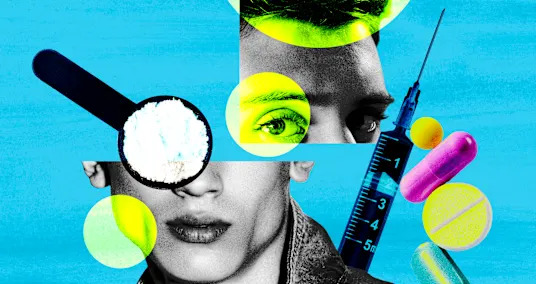
This year, a new strange online character emerged: a 20-year-old with the face of an elf prince (which he claims to have smashed to perfection with a hammer) and the body of a cartoon lifeguard (which he says he maintains through various substances, including meth). He walked the runway at New York Fashion Week, got arrested on felony drug charges, livestreamed himself saying racial slurs, sang along to the Kanye West song “Heil Hitler” with far-right influencers in a Miami nightclub, and was profiled by the New York Times and GQ along the way.
Braden Peters, known by the collarbone-inspired moniker Clavicular, catapulted to stardom because of the extreme and ridiculous lengths he went to in order to make himself hotter. It’s called looksmaxxing.
Although the practice has been popular for a certain subset of appearance-obsessed young men for several years, Clavicular’s turn in the spotlight is bringing the subculture more attention than ever. In becoming the internet’s fascination du jour, he’s also bizarrely brought the vernacular of that online community to the mainstream. People started jokingly throwing around gobbledygook like “mogging,” “gigachad,” “jester” and “foid” — and who could blame them? They sound funny. But there are darker implications too.
People started jokingly throwing around gobbledygook like ‘mogging,’ ‘gigachad,’ ‘jester’ and ‘foid’ — and who could blame them? They sound funny. But there are darker implications too.
Looksmaxxers speak, as the New York Times wrote, in dense terminology that’s been compared to “Geoffrey Chaucer’s Middle English; James Joyce’s ‘Ulysses’; ... the alienating dialect of the nihilistic goons in ‘A Clockwork Orange.’” They smash together suffixes and pseudoscientific terms with wild abandon. You might have heard that “Clavicular was mid jestergooning when a group of foids came & spiked his cortisol levels” or that “JESTERMAXXING at the club is officially the new meta.”
Beth Ribarsky, a communications and media professor at the University of Illinois Springfield, says these terms are “instantly catchy.” They’re silly, but we jokingly use them because we want to signal that we fit in. Slapping “-mogged” or “-maxxed” to the end of a word is an easy concept to understand, and thus, the language of looksmaxxers spreads easily.
But the gimmicky absurdity of the language and its widespread adoption is slowly infecting the rest of culture, and threatens to obscure the seedy origins and ethos of looksmaxxing, a physically dangerous enterprise that’s rooted in eugenics, racism and misogyny.
The dark side of looksmaxxing isn’t just smashing bones
Looksmaxxing began as a niche internet subculture discussed on clandestine online forums. These days, however, you can find discussions happening on popular platforms like TikTok and X. Looksmaxxers believe they can “level up” in life by improving their appearance — sometimes in small, harmless ways, like paying attention to skin care, dressing well and finding the right hairstyle. The most dedicated adherents take it to the extreme, injecting illicit chemicals and smashing bones. Still, everyone’s functioning under the same belief: To be hotter is to be more powerful.
For looksmaxxers, self-improvement is quantified and gamified, and beauty is a mathematical formula. They’re on a quest to get a higher number on the PSL scale, a convoluted attractiveness scoring system that assigns numerical values to certain features and ratios, which researchers say went mainstream on TikTok in 2023. The scale favors masculine and traditionally white features, and a higher score supposedly gets you the attention of more attractive women, bringing you to a class above others. This, of course, echoes the foundational logic of eugenics, though looksmaxxers believe they can attain success physically where their genetics have failed them, ascending the hierarchy instead of being eliminated entirely.
A low PSL score designates you “subhuman,” while a high score makes you a “Chad” if you’re a man or a “Stacy” if you’re a woman (although more often, women are called “foids,” short for “female androids”). The goal is to be a Chad who attracts a Stacy, but this isn’t ultimately about sex. Clavicular himself has said he’s been using testosterone for so long, he might as well be infertile; regardless, he’d rather know he could have sex with someone than actually do it. The real objective of looksmaxxing is to dominate everyone around you. Self-proclaimed “Chads” feel like they run the show when they’re the hottest man available, and they feel equally in control when they hijack our attention online.
Many looksmaxxing influencers have been banned from mainstream platforms, or they don’t have that many followers to begin with — for instance, Clavicular’s Instagram just crossed 500,000. Their biggest audiences are on second-tier, minimally moderated livestreaming platforms like Kick, where there aren’t enough users to exceed 10,000 live viewers on most days. Their content has to be “clipped” and reshared by accounts that get financial kickbacks — a practice known as clipfarming — to achieve widespread popularity. And that ecosystem is encouraging increasingly extreme behavior.
Why men are buying into the philosophy of looksmaxxing
I’m not here to argue that it’s not objectively funny that these influencers run around claiming to have “mogged” someone — a term meaning that they simply looked better than someone else, adapted from “AMOG,” an acronym for “alpha male of the group.” An X post saying that Clavicular was “brutally frame mogged” by a man called ASU Frat Leader went viral, causing Clavicular to descend on the “global Chad leaderboard” beneath someone named Androgenic (who later fell in the rankings when his wig was snatched during a livestream, revealing a less-than-ideal hairline.) Just reading that sentence makes this whole world reek of kayfabe, or the pageantry of professional wrestling. It’s “Jackass for the algorithm,” as Vice writes.
But don’t let the goofiness of it all fool you. The rise of mainstream looksmaxxers reveals not just intensifying beauty standards for men, but that the desire to dominate others is also gaining credence among a wider audience of boys and men. The tenets of looksmaxxing go hand in hand with the ideology of the manosphere, a broader and more mainstream part of the internet known for its outspoken anti-feminism influencers like Andrew Tate and Myron Gaines, who position men as superior.
A Common Sense Media survey found that 73% of boys regularly see masculinity content online. That includes posts about getting strong, becoming rich, embracing violence and reverting to traditional gender stereotypes. Not everyone exposed to this content will fall into the manosphere, but it’s easy to see how people could. Some boys and young men are drawn to these dark internet rabbit holes because they’ve felt rejected. Some just get swept into increasingly radical videos fed to them by their algorithms. Some are incels, or involuntary celibates, who believe they are unable to attract people sexually and thus feel powerless and victimized.
The belief that a man’s appearance dictates where he belongs in the “sexual marketplace” can snowball into the belief that it also controls his destiny, which means that the less attractive among them are at a disadvantage. They may subscribe to “red pill” beliefs and believe this hierarchy can be hacked to achieve dominance over women who would otherwise reject them; others take the “black pill” route, believing there’s nothing that can be done. The result is not acceptance — it’s nihilism, and in some cases violence. A man who killed six UC Santa Barbara students in 2014 openly said he was inspired by a misogynistic looksmaxxing forum.
Looksmaxxing is a profoundly antisocial endeavor focused obsessively on the self.
It’s also complicated by the fact that there’s a kernel of truth in looksmaxxers’ life philosophy. Zoe Yu, a writer and student at Harvard College, tells Yahoo that the young men are right about the fact that culture has become more superficial. “Most things are visual-first, algorithms are pushing out more conventionally attractive-looking influencers, dating apps assemble a handful of pictures to ask whether you want to swipe right or left, and what goes viral is usually the most inflammatory [and] the most provocative,” she says.
But this hierarchy isn’t as calcified and unassailable as it looks through a phone screen. In reality, there are plenty of women who date men under 6 feet tall, and plenty of thoughtful men who aren’t out to sleep with as many women as they can. But you don’t see this online because it doesn’t get as much attention. You might not even know this is possible if you’re not having interactions in the real world, and looksmaxxing is a profoundly antisocial endeavor focused obsessively on the self.
“As more and more young men interact with, and absorb, this caricature of women that they see online, the more that they’re going to buy into the looksmaxxing philosophy,” Yu adds. “What’s saddest about this whole ordeal is that young men probably just want, like all of us do, to feel loved — whether or not that’s getting into a relationship — but the bar to entry seems so high.”
Erin Pash, a therapist, tells Yahoo that looksmaxxing is concerning but not surprising. She’s been watching social media “systematically dismantle self-worth in young people for years.”
“Looksmaxxing is the logical end point of that pipeline — a culture that takes the already relentless pressure to look ‘good enough’ and reframes it as a personal optimization project,” she says. “Young men, especially, have been told that discipline and self-mastery are virtues, and this trend exploits that. It makes dangerous fixation feel like ambition.”
Take away all the things that are obviously bad — the eugenics, misogyny and cruelty — and you’ve still got a framework that treats your body as a problem to be solved. That’s not good either. Pash says that young men are experiencing a genuine identity crisis right now. For decades, conversations about body image and mental health centered on girls and women, which left boys growing up “without language for body-related shame or the cultural permission to express it,” Pash says.
That’s where online communities have swooped in, offering them a solution for their insecurities that seems mathematical and minimally emotional. But no self-improvement will ever feel like enough — the goalposts will move. Pash says young men and boys need to be honest with themselves about how what they see online makes them feel, and about what they’re truly craving. They need a community that isn’t fixated on appearance, and, in some instances, professional help. Overcoming insecurity isn’t quantifiable, but it is fixable. No hammers necessary.
LATEST POSTS
- 1
 The pace of hiring just fell to the lowest since 2011, outside of the pandemic
 - 21st results from Blue Ghost lunar lander reveal how much we still don't know about the moon
- 3Without evidence, CDC changes messaging on vaccines and autism
- 4The Conclusive Manual for Spending plan Travel: Opening Undertakings on a Tight budget
- 5Watch live as near-Earth asteroid Eros buzzes the Andromeda Galaxy on Nov. 30 (video)




- Jason Kelce opens about wife Kylie Kelce's past pregnancy loss
- 6 Famous Urban communities for Shopping on the planet
- Find the Interesting Universe of Computerized reasoning: the Capability of man-made intelligence
- Volkswagen Plant Could Pivot From Building Cars to Supporting Iron Dome Systems
- Remain Fit: Powerful Wellness and Work-out Schedules for a Better You
- First Phosphate advances battery-grade phosphate project as analysts highlight strategic Federal support
- Dominating Your Cash: The Fundamental Manual for Overseeing Individual accounting records
- Robyn returns to music with 'Dopamine,' her 1st single in 7 years: 'Came to save music once again'
- Doggie diversity in size and shape began at least 11,000 years ago