When you buy through links on our articles, Future and its syndication partners may earn a commission.

The first test flight of Landspace's Zhuque-3 rocket ended in a fiery explosion after successfully reaching orbit.
Chinese company Landspace launched its 216-foot (66-meter) stainless steel Zhuque-3 rocket from the Jiuquan Satellite Launch Center in the Gobi Desert in northern China on Tuesday (Dec. 2). The reusable, methane-liquid-oxygen-powered rocket successfully placed its expendable second stage in orbit, according to a statement from Landspace.
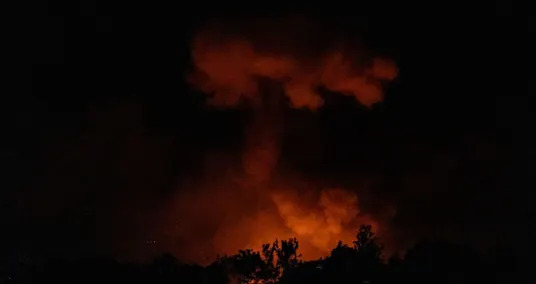
But after making a successful reentry, the rocket's first stage booster appeared to lose an engine during its landing burn and catch fire before crashing into the ground in a spectacular explosion. "An anomaly occurred as the first stage approached the designated recovery zone. No personnel safety issues occurred," Landspace wrote on social media. The company is now investigating the anomaly to discover its root cause.
Despite the landing failure, Landspace is hailing the test flight as a success, adding in its social media post that "China's first rocket recovery attempt achieved its expected technical objectives." These include verifying Zhuque-3's recovery system, engine throttling, and attitude control. Stills from videos of the crash landing show that the first stage landed within just meters of its target landing zone.
Zhuque-3 resembles SpaceX's dependable Falcon 9 rocket; both rockets feature a reusable first stage and an expendable upper stage and are powered by nine engines.
Zhuque-3's Tianque-12A engines are powered by a mixture of liquid methane and liquid oxygen (methalox), however, while the Falcon 9's Merlin engines burn liquid oxygen and rocket-grade kerosene.
Zhuque-3's payload capacity is similar to Falcon 9's as well, able to loft 40,350 pounds (18,300 kilograms) to low Earth orbit (LEO). Falcon 9, meanwhile, can send 50,265 pounds (22,800 kg) to LEO.
A Landspace previous rocket, Zhuque-2, became the world's first methane-powered rocket to reach orbit in July 2023. SpaceX's Raptor engine, which powers its Super Heavy booster and its Starship second stage vehicle, also burns liquid methane and liquid oxygen.
The Zhuque rockets are named for the vermillion bird from Chinese mythology that represents the fire element in Taoist five-element cosmological system.
LATEST POSTS
- 1
 Artemis II astronauts say they're "ready to go" for moon launch
 - 2Illustrations Gained from a Crosscountry Excursion
- 3Shrewd Home Gadgets to Save Energy
- 4The most effective method to Remain Ahead in the Most recent Advanced Patterns with a Web based Advertising Degree
- 5Trump administration launches new immigration crackdowns in New Orleans and Minneapolis. Here are all the cities it has targeted so far.


- US FDA grants market authorization to six on! PLUS nicotine pouch products
- Explosions at Burundi ammunition depot kill civilians, witnesses say
- Figuring out the Justification for Separation: To blame and No-Shortcoming
- The most effective method to Execute a Lung-Solid Eating routine After a Cellular breakdown in the lungs Finding
- Doctors say changes to US vaccine recommendations are confusing parents and could harm kids
- Hot Electric Vehicles for 2023
- 'Pluribus' release date: Everything you need to know about the new series from 'Better Call Saul's' co-creator
- Dental, Vision, and Hearing Inclusion in Senior Protection.
- Putin, Netanyahu discuss Middle East in phone call, Kremlin says