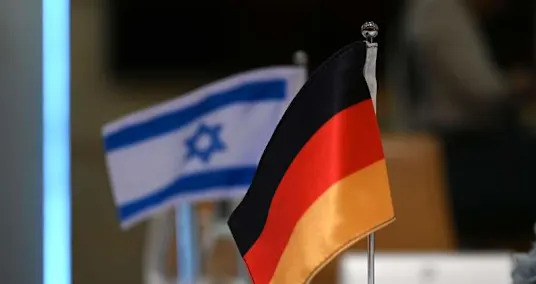
The German government on Tuesday expressed "great concern" over the Israeli parliament's decision to introduce the death penalty for convicted terrorists.
"Understandably, Israel has taken a hard line against terrorism since October 7," said government spokesman Stefan Kornelius in Berlin. "However, the German government views the law passed yesterday with great concern."
Opposition to the death penalty is a fundamental feature of German policy, he said.
The German government is also concerned that such a law "would likely apply exclusively to Palestinians in the Palestinian territories," Kornelius added. "It therefore regrets the Knesset’s decision and cannot endorse it."
The Knesset, Israel's parliament, approved the bill on Monday. It provides that the death penalty or life imprisonment may be imposed for terrorist-motivated murder with the aim of destroying the State of Israel.
Israel abolished the death penalty for murder in 1954 and retained it only in exceptional cases. The execution of the German Nazi criminal Adolf Eichmann in 1962 was the last carried out in Israel.
LATEST POSTS
- 1
 Inn The executives: A Remunerating Profession Decision for Energetic People
 - 2Image of foreigners being arrested in S.Africa during Eid is AI-generated
- 3These are the Fastest Italian Sports Cars
- 4NAFFIC and Aware to Launch First China-Europe Digital Product Passport
- 5Former school bus aide pleads guilty to assaulting 3 autistic students in Colorado




- How is 'A Knight of the Seven Kingdoms' connected to 'Game of Thrones'?
- ISS astronaut evacuation shouldn't interfere with upcoming Artemis 2 moon mission, NASA chief says
- Munich Security Conference chief defends inviting AfD lawmakers
- Interstellar comet 3I/ATLAS reveals weird wobbling jets in rare sun-facing tail
- Historic underwater structure discovered by divers off French coast
- Artemis 2 astronauts see Earth in the rear-view mirror | Space photo of the day for April 3, 2026
- New dietary guidelines recommend more dairy, meat and fats: What to know
- RSF attack on Sudan’s South Kordofan kills at least 14, including children
- Air travelers face higher ticket prices as Iran war drives up oil prices