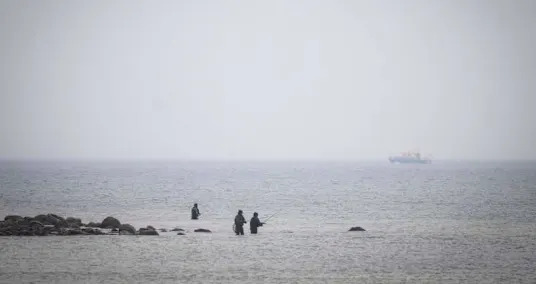
A humpback whale stranded for days off Germany's Baltic coast has gotten stuck on another sandbank, a Greenpeace spokeswoman said on Saturday.
The unlucky animal had garnered media attention for days, after it got stranded on a sandbank off Germany's Timmendorfer Strand resort, near the city of Lübeck, early on Monday.
Days of efforts to free the 12- to 15-metre whale proved unsuccessful until rescuers dug out a channel in the sand around the animal using a floating excavator on Thursday, allowing the whale to swim free the following night.
However, environmentalists and marine experts had feared that the animal could potentially get stuck again, as it was spotted heading back towards shallower water following its release.
Those fears became reality on Saturday, with the whale spotted stranded on a sandbank in the Bay of Wismar, some 40 kilometres to the east of Timmendorfer Strand, according to Greenpeace.
Large whales such as humpback whales are not native to the Baltic Sea. They may follow schools of fish in search of food and end up in the Baltic Sea.
According to experts, underwater noise could also play a role.

LATEST POSTS
- 1
 Astrophotographer captures rare footage of the Hubble Telescope crossing the sun (video)
 - 2Canada cancels its 1st moon rover: 'It's hopefully not a lost cause'
- 3Finding the Universe of Computer generated Reality: Individual Encounters
- 4New law puts familiar drinks, creams and gummies in legal limbo
- 5Ryan Gosling responds to Deidre Hall's invitation to visit the 'Days of Our Lives' set: 'This is a very enthusiastic yes'





- Find the Excellence of Old style Expressive dance: Encountering the Effortlessness and Polish of Dance
- Famous Network programs in Europe and America
- Style Narratives: A Survey of \Patterns and Styles Assessed\ Design
- Anger as German family business group opens talks with far-right AfD
- Flu cases are rising with a strain that makes older people sicker
- German diesel hits new records over Easter weekend
- Israel approves death penalty law for Palestinians convicted of attacks
- Merck sees over $5 billion opportunity in Cidara's experimental flu drug
- How C-reactive protein outpaced ‘bad’ cholesterol as leading heart disease risk marker